Content to Engage With
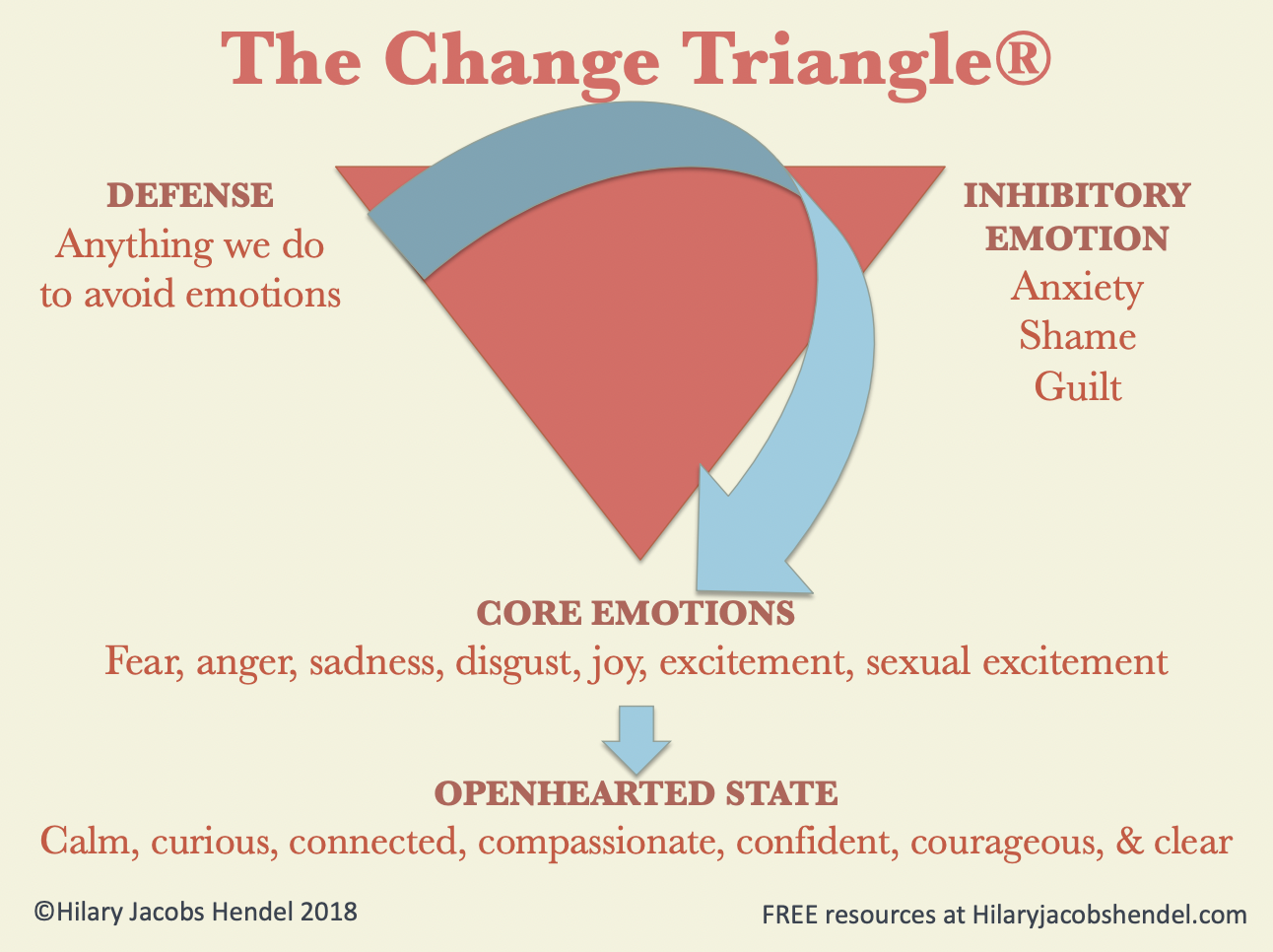
The Change Triangle: Defenses
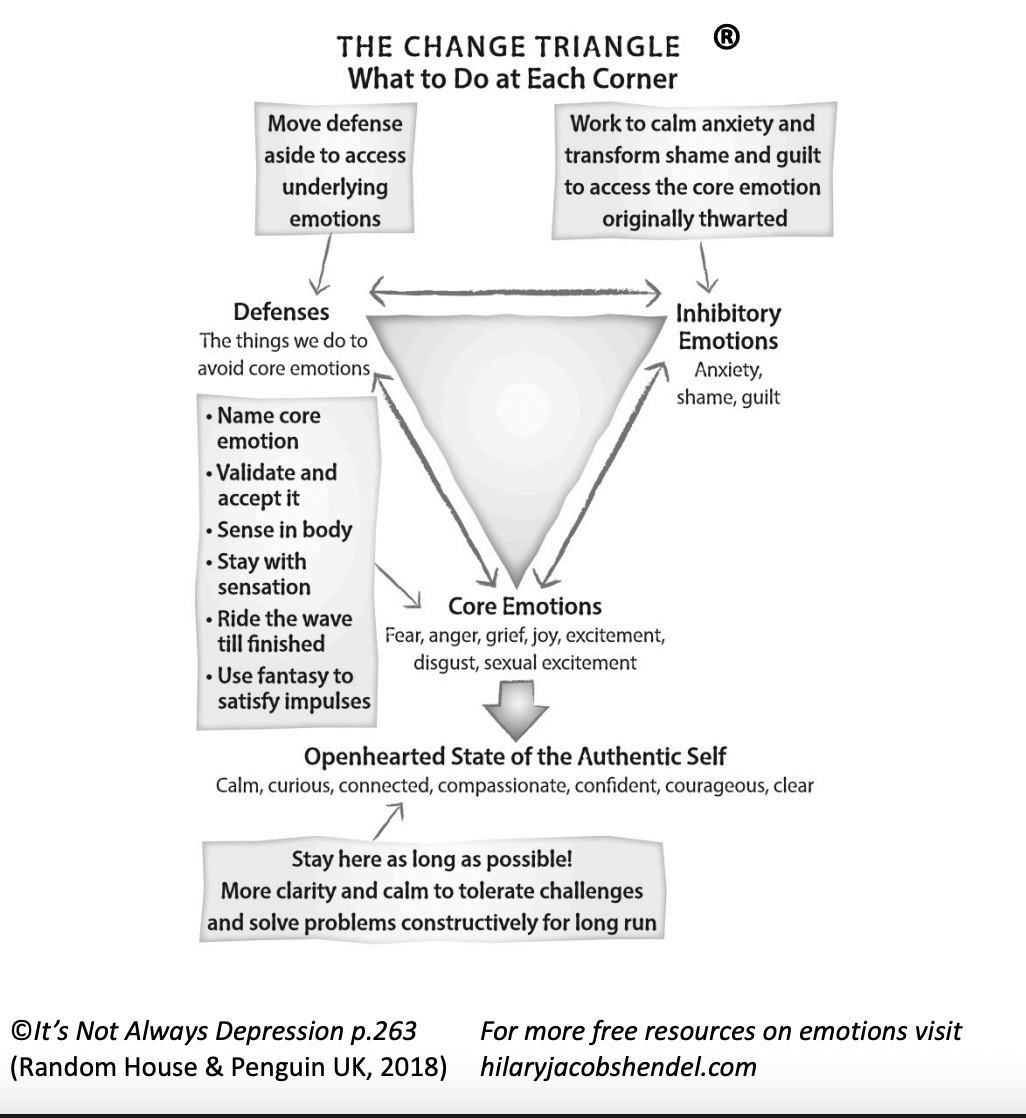
As we continue our work with the Change Triangle, developed by psychotherapist Hilary Jacobs Hendel, we are going to turn our attention toward our current defenses—the ways we may be avoiding, moving away from, or protecting ourselves from emotions in the present moment.
Whether you are already familiar with the Change Triangle or this is a newer practice for you, there is value in slowing down and paying attention to what is happening right now. We do not need to perfectly understand our history or figure everything out before we can begin. Sometimes, simply noticing what shows up in the present moment can give us important information about what we need.
Outline
Content Portion ~ 5 - 20 minutes
Reflection Portion ~ 10 - 30 minutes
Invitation for How to Engage
Watch the video by Hilary Jacobs Hendel on defenses
Read over and engage in the resources on defenses
Carve out some time to either journal, converse with someone else, or simply consider the reflection questions (You can answer all or pick and choose) and participate in the daily homework
If you would like additional resources and want to dive deeper, check out the additional resources section
Understanding Our Defenses
First, let’s normalize this: we all use defenses. We develop ways of protecting ourselves from painful, uncomfortable, or overwhelming emotions because, quite simply, those emotions can be hard to sit with. Defenses are not signs that something is wrong with us. They are adaptations—ways our minds and bodies have learned to help us cope with the vulnerabilities and challenges of being human.
Defenses are purposeful. At some point, they likely helped us feel safer, more in control, less vulnerable, or better able to navigate a difficult situation. The challenge is that a strategy that was helpful at one point in our lives may not always serve us in the same way today. Our defenses can protect us from discomfort, but they can also come with a cost. Sometimes they create distance from the very things we most want: connection with ourselves, with other people, and with the world around us.
As we begin to notice our own defenses, I invite you to move away from thinking of them as “good” or “bad.” Instead, try approaching them with curiosity:
What is this defense trying to protect me from?
What feeling or vulnerability might be underneath it?
When does this strategy tend to show up?
How does it help me in the short term?
What might it be costing me in the long term?
Is this strategy still helping me in the way I need it to?
The goal is not to eliminate our defenses. In fact, trying to get rid of them can sometimes create even more shame or self-criticism. Instead, the goal is to become more aware of them so that we have more choice in how we respond. We can begin to recognize when a protective strategy is showing up and gently ask ourselves whether we still need it in that moment.
Reflection
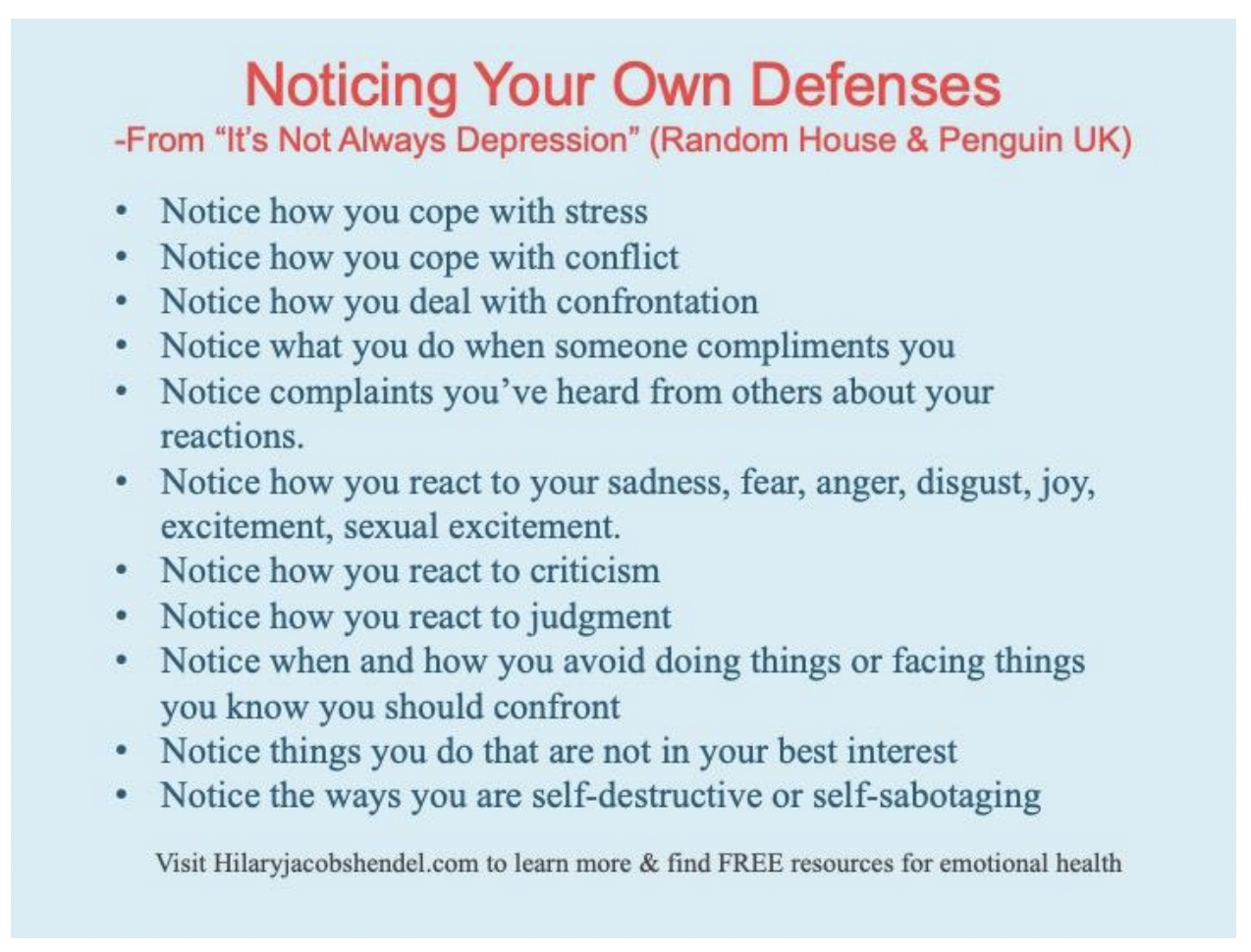
The questions in this section come from the book, It’s Not Always Depression by Hilary Jacobs Hendel and can be a helpful launch point for reflecting on our defenses. I invite you to take some time to sit with, journal about, or discuss your answers to these questions (continuing to practice self compassion throughout).
Homework:
Throughout the week, continue to pause and notice Where am I on the Triangle?
**The information contained herein is not therapeutic advice nor a substitute for therapy. It should not be used to diagnose or treat any mental health problem. If you are located within the United States and you need emergency assistance please call 911 or go to your nearest emergency room. If you are located within Colorado you may also call the Colorado Crisis Line at 844-493-TALK (8255).

Common Defenses
Defenses can look very different from person to person. Sometimes they are obvious; other times, they can be so familiar that we hardly recognize them as protective strategies.
Avoidance: Staying away from situations, people, conversations, thoughts, or feelings that feel uncomfortable or threatening.
“If I don’t think about it, I don’t have to feel it.”
Intellectualizing: Moving into thinking, analyzing, researching, or problem-solving rather than allowing ourselves to experience the emotions underneath.
“I can explain exactly why this happened, but I’m not sure what I actually feel about it.”
Rationalizing: Creating logical explanations for something that may be emotionally difficult to acknowledge.
“It doesn’t really matter anyway. I probably didn’t want it.”
People-pleasing: Focusing heavily on other people’s needs, feelings, or expectations in order to avoid conflict, rejection, disappointment, or the discomfort of prioritizing ourselves.
“It’s easier to just say yes than risk someone being upset with me.”
Perfectionism: Trying to prevent mistakes, criticism, rejection, or feelings of inadequacy by setting extremely high standards for ourselves.
“If I can just do this perfectly, I won’t have to feel like I’m not enough.”
Control: Attempting to manage people, situations, or outcomes in order to create a sense of safety and reduce uncertainty.
“If I can anticipate everything and make sure everything goes according to plan, I’ll be okay.”
Deflection or humor: Using jokes, changing the subject, or making light of something when emotions begin to feel too vulnerable.
“I’m fine—I’m just joking!”
Anger or irritability: Sometimes anger can become a protective layer over more vulnerable emotions such as sadness, fear, hurt, shame, or helplessness.
“It’s easier for me to be angry than to admit that I’m hurt.”
Withdrawal: Pulling away, becoming quiet, or emotionally shutting down when connection feels overwhelming or unsafe.
“I just need to be alone. I don’t want to deal with this right now.”
Over-functioning or staying busy: Keeping ourselves constantly occupied so that we have less space to slow down and encounter difficult thoughts or feelings.
“If I keep moving, I don’t have to think about what’s actually going on.”
Minimizing: Downplaying our own experiences or emotions because acknowledging them feels uncomfortable, inconvenient, or too vulnerable.
“It wasn’t that bad. Other people have it much worse.”
Self-criticism: Turning difficult emotions inward and blaming ourselves as a way of creating a sense of control or preventing future mistakes.
“If I’m hard enough on myself, maybe I can make sure I never do that again.”
Distraction: Turning toward work, social media, food, entertainment, substances, exercise, or other activities to move away from uncomfortable internal experiences.
“I just need something to take my mind off of this.”
None of these strategies automatically mean something is wrong. The important question is not simply, “What defense am I using?” but “What is this defense doing for me?”
For example, avoidance might give us immediate relief from anxiety, while also keeping us from discovering that we are capable of handling the situation. Perfectionism might help us feel accomplished and in control, while also leaving little room for rest, mistakes, or self-compassion. People-pleasing might help us maintain harmony in the short term, while gradually creating resentment or disconnection from our own needs.
This is where curiosity becomes so powerful. Rather than judging ourselves for having defenses, we can begin to recognize the wisdom behind them while also becoming honest about their costs.
You might even try saying to yourself:
“Of course I developed this strategy. It makes sense that some part of me is trying to protect me.”
The goal is not to become a person who never feels uncomfortable or never uses defenses. The goal is to become someone who can notice what is happening, and have agency to move our defenses aside to access underlying emotions as we want.