Content to Engage With
The Change Triangle
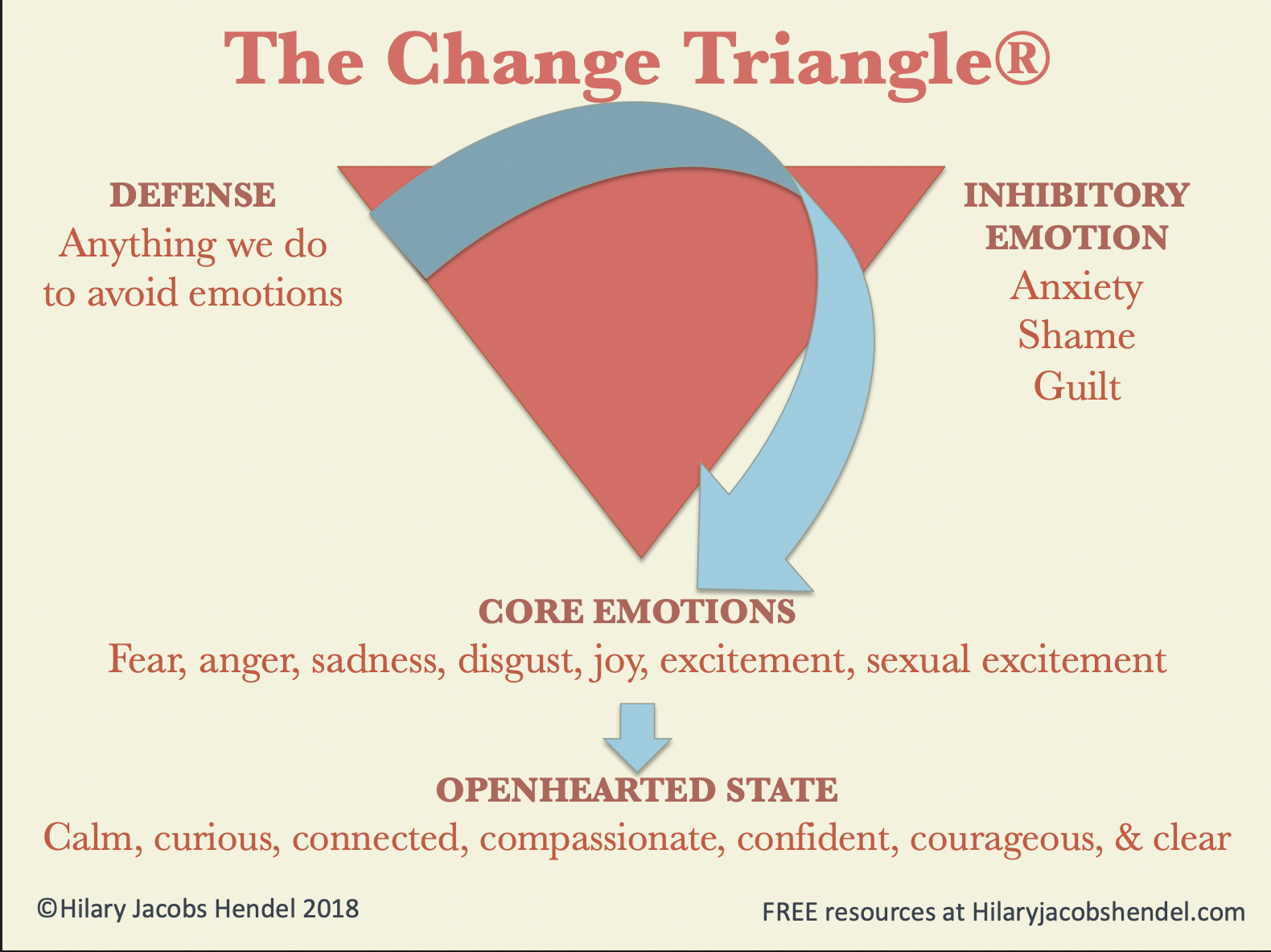
The following is a simple yet powerful tool designed by Hilary Jacobs Hendel that can help guide us back from defenses and states of emotional distress to our calm, confident, and connected Selves. The next few sections will all work with the Change Triangle and will build on one another. My hope is that these tools will help you build self-awareness and empowerment on your own journey — while giving you the chance to explore a growth mindset, practice self-compassion, and continue developing real, usable skills that build a sense of confidence and agency.
Special thanks to Hilary Jacobs Hendel, who has made her work accessible and who has generously given permission for it to be used and disseminated.
Outline
Content Portion ~ 5 minutes - 1 hr
Reflection Portion ~ 10 - 30 minutes
Invitation for How to Engage
Watch the video by Hilary Jacobs Hendel and engage with the other videos below if you would like longer explanations
Read over the change triangle overview
Carve out some time to either journal, converse with someone else, or simply consider the reflection questions (You can answer all or pick and choose) and participate in the daily homework
If you would like additional resources and want to dive deeper, check out the additional resources section
Introduction to the Change Triangle
The main video above gives a brief introduction to the concept of the change triangle. Below are longer videos for those who want to go deeper:
Medium Length Video (~ 7 mins): https://mytherapynyc.com/change-triangle-emotional-health/
Long Video (~ 1 hour): Called “Full Presentation on the Change Triangle: https://www.hilaryjacobshendel.com/instructional-videos
More About Each Part of the Triangle
This link leads to a resource from Hilary Jacobs Hendel that explores each part of the Change Triangle in more depth — defenses, inhibitory emotions, core emotions, and the open-hearted state: https://www.hilaryjacobshendel.com/whats-the-change-triangle
A brief summary:
Defenses
Defenses are the habitual ways we protect ourselves from feeling something too overwhelming, too unfamiliar, or too unsafe to feel. They're not flaws — they're old strategies that once helped us cope, often formed long before we had better tools available. Defenses can look like avoidance, distraction, intellectualizing, people-pleasing, humor, numbing, isolating, or even staying busy so there's no room left to feel. Noticing a defense isn't a sign you're doing something wrong; it's actually valuable information — a signal that something underneath wants your attention.
Inhibitory Emotions
Inhibitory emotions — primarily anxiety, shame, and guilt — tend to show up as a kind of internal alarm system, blocking core emotions before they can be fully felt. They often developed for good reason: maybe expressing anger wasn't safe in your family growing up, or sadness was met with discomfort rather than comfort. These emotions aren't "bad," but they can keep us stuck in distress rather than moving through it, because they prevent the core emotion underneath from being felt, processed, and released.
Core Emotions
Core emotions are the seven biologically hardwired emotions we're born with: anger, sadness, fear, disgust, joy, excitement, and sexual excitement. Unlike inhibitory emotions, core emotions are meant to move — they arise, they're felt in the body, and they pass, typically within about 90 seconds if we let them. When we allow ourselves to actually experience a core emotion rather than defend against it or get stuck in anxiety/shame/guilt about it, we free up enormous energy and move closer to clarity and calm.
Open-Hearted State
The open-hearted state is what becomes available on the other side of core emotion — the calm, connected, grounded place where we can access curiosity, compassion, courage, clarity, confidence, and creativity (often referred to as the "C" qualities). This is the state we're working toward throughout this process: not the absence of difficult emotion, but the capacity to move through it and land somewhere more spacious, connected to ourselves and to others.ary
Reflection
Pause and wonder: Where am I on the Triangle?
Am I defending? (e.g., blaming, zoning out, people-pleasing, overthinking?)
Am I anxious, ashamed, or guilty?
Or am I feeling a core emotion?
For right now, practice not judging where you are, just noticing. Your homework is to pause once a day and just notice where you might be on the change triangle.

**The information contained herein is not therapeutic advice nor a substitute for therapy. It should not be used to diagnose or treat any mental health problem. If you are located within the United States and you need emergency assistance please call 911 or go to your nearest emergency room. If you are located within Colorado you may also call the Colorado Crisis Line at 844-493-TALK (8255).